“When I despair, I remember that all through history the way of truth and love have always won. There have been tyrants and murderers, and for a time, they can seem invincible, but in the end, they always fall. Think of it–always.”
” I love you without knowing how, or when, or from where. I love you simply, without problems or pride: I love you in this way because I do not know any other way of loving but this, in which there is no I or you, so intimate that your hand upon my chest is my hand, so intimate that when I fall asleep your eyes close.”
–Pablo Neruda
Pablo Neruda (1904-1973) was a beloved Chilean poet who won the Nobel Prize for Literature in 1971. He wrote in green ink which was his symbol for desire and hope.
The Beautiful and Romantic Music of Bernard Herrmann
Bernard Herrmann (1911-1975) was a composer who wrote the scores for many famous films. He wrote the scores for the Orson Welles films Citizen Kane,The Magnificent Ambersons and the score for Jane Eyre (1944) that starred Joan Fontaine and Orson Welles. I like this version of Jane Eyre the best.
Hermann wrote the scores for 7 Alfred Hitchcock films including Vertigo. The Love Scene music from Vertigo was used in the more recent film The Artist. I thought it was very wrong that Bernard Herrmann was not mentioned in the credits of this film. When I heard the music I recognized it right away as being originally part of the score for Vertigo.
Here via Roberto Mastrosimone on You Tube is Esa-Pekka Salonen and the LA Philharmonic performing Bernard Hermann’s Scene D’Amour from Vertigo:
“Think before you speak is criticism’s motto; speak before you think, creation’s.”
–E. M. Forster
E. M. Forster (1879-1970) a well known and acclaimed English author who wrote A Room With a View, A Passage to India, and Howard’s End. All were made into films. I have seen all these films but not read the books. His books dealt with the class system in England, their values, and the shifting of power that was occurring in the early 20th century.
Battery Low, Need to Plug into Energy Source to Recharge
When things get to me
It is a kind of draining
Like when you see the battery indicator on your cell phone
Showing the charge is getting low
My energy level goes down along with my spirits
Feeling low
Have to allow time to recover and get recharged.
The Opposite of Low is Elation or Passion
I wrote this on a prior post:
Too Passionate
I think there is a passionate temperament. A person that can feel so strongly. There have been many times when I have been standing upon my soapbox and declaring my opinion about something I found wrong in the world.
During those times of strong emotion I have noted others looking on calmly, almost disinterested. I have thought to myself how can they not feel anything about this? How can anyone not feel strongly about this ? How can people feel so dispassionately about things? It is like they are already dead.
I realized that I was different.
It is not just passionate indignation that I feel. When you have the capacity for strong feelings you can feel great joy and elation as well. Like when you see something you find beautiful or hear music that you love.
I am glad I am different if it means to feel deeply and be more aware in the world. Maybe this is why I always wanted to stand up for people’s right to be different. To be who they truly are.
Have you ever felt different or been told you are different?
Some people are sensitive.
“The truly creative mind in any field is no more than this:
A human creature born abnormally, inhumanly sensitive.
To him…a touch is a blow,
a sound is a noise,
a misfortune is a tragedy,
a joy is an ecstasy,
a friend is a lover,
a lover is a god,
and failure is death.”–Pearl S. Buck
Beautiful Voice: Renee Fleming sings Song to the Moon by Dvorak via Mr.Frais on You Tube:
Some fun and hopefully humorous writing as part of my Making Blogging More Enjoyable for Me Project. My posts may not follow a regular schedule. Just when I feel inspired to do so.
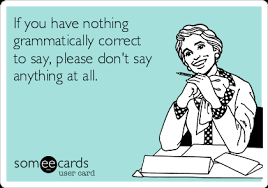
I have seen some evidence in the comment section of my blog and from accounts given by fellow bloggers of a certain condition called Grammar Pedant Disorder (GPD). I will attempt to give a description of this disorder. Or at least traits I have identified so far and how I imagine that they develop. This is not a scientific study but based on anecdotal evidence and accounts. I do not claim to be an expert.
Signs of Beginning Grammar Pedant Disorder (GPD) or Stage I:
You find yourself feeling a certain smugness and slight superiority when spotting small errors in others writing. Things like word omissions, typos, and accidentally using the wrong word like their for there.
You would never think of pointing this out to the person in public.
The errors will not stop you from continuing to read the person’s writing.
Signs of Moderate GPD or Stage II:
You are noticing more grammar errors in others writing.
You can easily understand the errors, and know what the author meant to say, but you find yourself tsk tsk-ing to yourself.
You are starting to feel a bit edgy when you detect the errors.
You may find yourself tempted to point out the error. It is getting harder not to point it out. Your fingers quiver over your computer keyboard as you stare at the writer’s comment section.
You start to question if the caliber of writing is worth your time to read.
Signs of Full Blown GPD or Stage III:
You notice every error, no matter how minor, in others writing and it really irritates you. You are personally affronted by having to be exposed to such noxious things.
There is a whole long list of things that offend your sensibilities. And you find yourself carefully scrutinizing the writing of others to make sure none of these things are found.
You may have your special pet peeves that really get your goat.
You find you must actively avoid reading any samples of writing that contain any of the faults on your list.
There is a real danger at this point that you will develop a more severe form of this condition. This is where you actively point out the errors of other writers in their comment sections in a passive-aggressive way or with full blown nastiness.
This disorder has been in evidence for quite some time and now the medical community is taking note of it. There have been discussions of listing it as a category of mental illness in the DSM. If you feel you may be experiencing some of the signs and symptoms of this condition you should contact your doctor. There are support groups available in some communities for those wanting to recover from GPD.
This post is provided as a public service to new writers who may unknowingly come under the scrutiny of a person suffering with GPD. Having someone with this disorder as your mentor or Imaginary Reader is not recommended. It is also provided as a self-awareness exercise to guard against these traits developing in you.
Additional reading on this topic: I found an essay on Medium.com by a young lady, Mary Rolf, who identifies herself as a former Grammar Snob. She writes very eloquently about all the reasons she decided not be a snob. I have recently had thoughts similar to hers so her writing really resonated with me. If you think you suffer from GPD or think you could be described as a Grammar Snob I recommend you consider some of her arguments against it. https://medium.com/i-m-h-o/why-i-stopped-being-a-grammar-snob-aac6634d79af
I also recommend the book, ” Bad English, A History of Linguistic Aggravation,” by Ammon Shea
“A label is a mask life wears. We put labels on life all the time. “Right,” “wrong,” “success,” “failure,” “lucky,” “unlucky,” may be as limiting a way of seeing things as “diabetic,” “epileptic,” “manic-depressive,” or even “invalid.” Labeling sets up an expectation of life that is often so compelling we can no longer see things as they really are. This expectation often gives us a false sense of familiarity toward something that is really new and unprecedented. We are in relationship with our expectations and not with life itself.”
–Rachel Naomi Remen
Rachel Naomi Remen is a doctor and author. I have read both her books several times. Sometimes I like to read them before going to sleep at night because they give me inspiration and peace. The two books I am referring to are “Kitchen Table Wisdom” and My Grandfather’s Blessing.”
Rachel struggled with her own chronic illness and still managed to get through medical school. She became a doctor when women in medicine were not often welcomed and accepted. She started out as a Pediatrician and later counseled people battling cancer. She is a member of the faculty at the University of California San Francisco Medical School. She founded the Commonweal Cancer Help Program in Northern California with Dr. Michael Lerner.
“There are people who embrace the Oxford comma and those that don’t, and I’ll just say this: never get between these people when drink has been taken.”–Lynn Truss
Unsolicited corrections of others writing is not a helpful thing. I am happy that I have not experienced it very much. But this came home to me when I read another blogger apologizing for his grammar mistakes. He went on to say something like he was learning and to cut him some slack. I interpreted this as telling the grammar police, to back off ,in a nice way. Another blogger referred to these critics as “Grammar Nazis.” I believe it is a type of trolling.
Even though I have not been “corrected” often, I did find the experience caused me to hesitate when writing and wonder if I was making mistakes.
This is wrong. We are not writing essays for an English class. If we are going to be published in a magazine, newspaper or book the editors can advise us.
I have a blogging friend who is a grammar expert and writes a blog criticizing grammar mistakes in well-known publications. I did say to her once, that I felt I could be making grammar mistakes and, as she was one of my readers, was a bit self-conscious. She said I did not have a staff of editors like a big newspaper and therefore should not worry. I hope she meant that in a good way. Not that I was making tons of mistakes but, after all, I do not have an editor. 🙂 She has liked my writing.
Blogging lends itself to a stream of consciousness style of writing. If I am truly writing that way, I am probably making errors. Sometimes I catch them and sometimes I don’t. And sometimes I don’t realize I am making them. If my writing is truly unclear, the reader can ask for clarification.
I read that Jack Kerouac did not use periods, wrote on a long scroll, and did not edit himself. I have read a few quotes from his writing and feel, if I could write as good as he did, I would feel fine about leaving out a few periods
Blogging can be a format for experimentation and play. Bloggers are creating something out of their unique perspectives and engaged in exploration. I don’t think they should be held back and made self-conscious by having their grammar mistakes pointed out on their blogs.
I did a bit of experimentation myself with this verse:
A most inspiring true story. The story of a courageous race horse named Seabiscuit.
Seabiscuit is one of the most famous race horses in America. He was ranked one of the top ten race horses in the 20th century. I first read the whole story about Seabiscuit in Laura Hillenbrand’s book of the same name. It is a wonderfully inspiring story about an unlikely race horse hero and his entrepreneurial owner, horse whisperer trainer, and slightly overweight and partially blind jockey. Seabiscuit captured my imagination when I read his story and that of the American public during the dark times of the Depression. Laura Hillenbrand’s story is pretty inspiring as well. She suffers from chronic fatigue syndrome and is often confined to her home. She wrote another book about an unstoppable WWII hero Louis Zamperini called, “Unbroken.” It is the amazing story of his survival as a POW of the Japanese after his plane crashed in the Pacific Ocean. Both books are highly recommended by me.
Here is an interesting documentary about Seabiscuit via Horse Racing on you tube:
“Read, read, read. Read everything — trash, classics, good and bad, and see how they do it. Just like a carpenter who works as an apprentice and studies the master. Read! You’ll absorb it. Then write. If it’s good, you’ll find out. If it’s not, throw it out of the window.” ― William Faulkner
Well I should be able to write pretty good by now because I do read so much. I agree with this quote because I think you can pick up how to be more articulate in writing by reading others work. I read a bit of Faulkner’s biography and learned he received the Nobel Prize in Literature in 1949. He never graduated from high school. He used some of his Nobel Prize money to help establish the PEN/Faulkner Award for Fiction. I like the part in the quote where he says if the writing is not good you can throw it out the window. He developed his unique style. I think all writers need to develop their own style. Try not to compare yourself to others or copy others.




 Notes Tied On The Sagebrush