I like happy endings to stories. I like to have things come out right in the end. You might think I am pretty naive. That is not real life you say. It is more important and worthwhile, even great writing, to tell it like it is. I can read the newspaper if I want stories about all the bad in the world. It is satisfying to have things work out positively. It gives us hope about life and the possibility of good in the world.
Once a month I participate in the We Are The World Blogfest sharing positive stories about people making a positive impact in the world. Seems like you have to search through the news nowadays to find these stories. One source I have is Gratefulness.org. and their monthly Gratefulness News. In it, I found a post about community health workers in Kenya who bring healthcare access to impoverished and remote areas, “Meet the ‘backpack midwife’ bringing healthcare for all.” Phillips Africa is the company that developed the backpack and is “working with local government, Philips is developing a number of community life centres to support community health workers and midwives equipped with these hi-tech backpacks.”
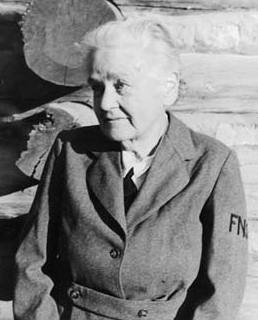
This story reminds me of the Frontier Nursing Service (FNS) of the 1930s, founded by Mary Breckinridge a public health nurse and midwife, in the state of Kentucky in the United States. Nurse midwives brought obstetric care to women in Appalachia by horseback, their supplies in saddlebags.
“The nurse-midwife carried all of these materials in her saddlebags because she was usually far from both her outpost center and the small FNS hospital; she had to be prepared for whatever she found. With the help of the equipment in those saddlebags, FNS nurse-midwives lost astoundingly few mothers. FNS was a great success by any measure….Kentucky, the birthplace of American nurse-midwifery, now houses Frontier Nursing University, which has provided graduate education to nurse-midwives (and more recently, nurse practitioners) since 1939. This university combines distance education and clinical work in the student’s own community to educate a significant percentage of American nurse-midwives.”-Midwives on Horseback: Saddlebags and Science
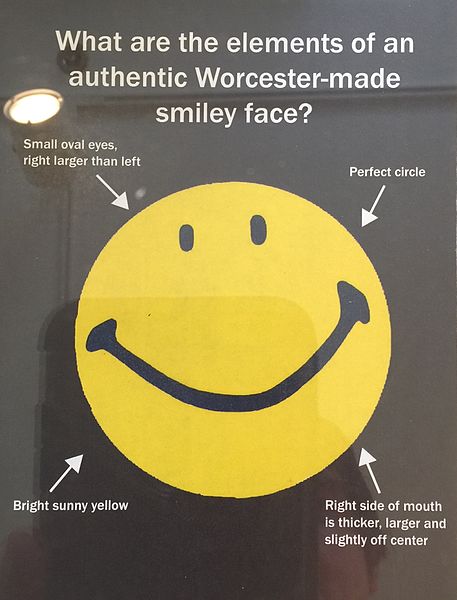
This month for the We Are The World Blogfest I am sharing a light-hearted little story I found from Smithsonian.org. We all use the little smiley face emoji with our blogs all the time. This article The Proliferation of Happiness shares a brief history of Positive Psychology and a bit about the man who invented the ‘smiley face.’
“It took only ten minutes for Harvey Ball to create the Smiley face. In 1963, the State Mutual Life Assurance Company in Worcester, Massachusetts, hired him to come up with a design that would help raise the morale of its employees.”
Harvey Ball was an artist and trained sign painter who was paid $45 for the design. The original Smiley face was not patented, but he did license one version with his World Smile Corporation in 1999. “The Corporation licenses Smileys and organizes World Smile Day World Smile Day raises money for the Harvey Ball World Smile Foundation, a non-profit charitable trust that supports children’s causes. World Smile Day is held on the first Friday of October each year and is a day dedicated to “good cheer and good works”. The catch phrase for the day is “Do an act of kindness – help one person smile”.-Wikipedia.
You may think I went a tad overboard this month, and I probably did, but I wanted to shine a big light on the issue of gender equity in STEM careers. I am sharing stories about women in science who have had to overcome stereotypes about their gender to pursue careers in science. I am in awe of these women who continued studying and working in spite of all the barriers in their path. Part of the problem besides outright prejudice and discrimination may be that we do not read about these women in the media as often as we read about male scientists. So I mentioned two journalists who decided to analyze and remedy the lack of gender equity in their reporting. And I included what some organizations and companies are doing to bring more women into careers in the sciences. The stories about women in science definitely demonstrate resilience of the human spirit.
Nancy Grace Roman was told women can’t be scientists. It is a good thing she didn’t listen to that opinion. Here is a short video about Dr. Roman’s story in her own words courtesy of NASA’s Goddard Space Flight Center/Katrina Jackson.
In the video Dr. Roman states that people are often not interested in how things got started. I think because we don’t read or hear stories about women in science we assume they don’t exist. Ed Yong in his Atlantic article talks about gender imbalance in science reporting. He talks about how he realized he was leaving women scientists out of his reporting and how he made the effort to remedy that. He mentions an example of his own writing in December 2015 about a conference on CRISPER, where he quotes six men and one woman which might indicate a lack of women working in the field. He writes this was:
“…all the more egregious because the CRISPR field is hardly short of excellent, prominent female scientists. Indeed, two of the technique’s pioneers, Emmanuelle Charpentier and Jennifer Doudna, are women, and both of them spoke at the same conference from which I reported. And yet, if you read my piece, you could be forgiven for thinking that CRISPR was almost entirely the work of men.”-Ed Yong
If we never read about women in science, it is like they do not exist. He mentions his colleague Adrianne LaFrance who did a study with the help of a computer scientist at MIT on the proportion of women scientists she had been including in her articles and found it was much lower compared to men. She says:
“These numbers are distressing, particularly because my beats cover areas where women are already outnumbered by men—robotics, artificial intelligence, archaeology, astronomy, etc. Which means that, by failing to quote or mention very many women, I’m one of the forces actively contributing to a world in which women’s skills and accomplishments are undermined or ignored, and women are excluded.”-Adrienne LaFrance
You might argue that more women scientists do not exist or are less qualified to be quoted. Yong found this was not the case he just needed to look in the right places.
“It is getting increasingly easy to find such people. The journalist Christina Selby, writing at the Open Notebook, compiled a list of tips for diversifying sources. The journalist Mollie Bloudoff-Indelicato created Diverse Sources, a searchable database of underrepresented experts in science. 500 Women Scientists, a nonprofit, created Request a Woman Scientist, a similar (and larger) database. Both can be filtered by country, specialty, and more. Several scientists have compiled lists of women in microbiology, astronomy, physics, evolution, political science, neuroscience, and more. I keep a personal list of women and people of color who work in the beats that I usually cover. And if these all fail, the most basic journalistic method always works: Ask someone. Get people in the field to suggest names.”-Yong
And TED Talk by Kimberly Bryant founder of Black Girls Code. Ms. Bryant wants to encourage women and girls of color to pursue careers in tech and is helping with her nonprofit:
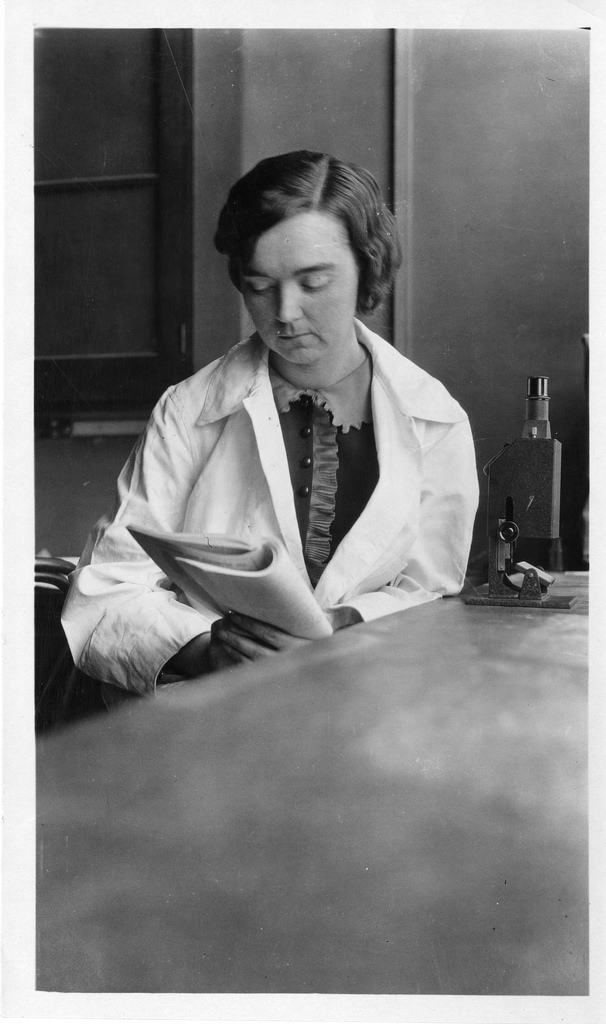
*Featured Image at top of page: “Mary Van Rensselaer Buell (1893-1969), sitting in lab with microscope, reading paper” from Smithsonian Institute via Flickr. Creator/Photographer: Julian Scott Description: In 1919, Mary Van Rensselaer Buell (1893-1969) became the first woman to earn Ph.D. in biochemistry at the University of Wisconsin. She carried on her extensive research on nutrition and physiological chemistry at University of Iowa, Johns Hopkins University, Washington University, and the University of Chicago.
Can children be taught kindness? That is the goal of a program being taught in a Pre-kindergarten classroom in Queens, New York and in other preschool programs around the US based on “the Kindness Curriculum, developed by the Center for Healthy Minds at the University of Wisconsin, Madison, in which preschoolers are introduced to a potpourri of sensory games, songs and stories that are designed to help them pay closer attention to their emotions,” ( New York Times).In the program children are taught to recognize their own emotions and become sensitive to the feelings of others, to show kindness toward others. Children who have received this training do become more altruistic but the lessons must be reinforced as children get older.
Seems like a worthwhile addition to school curriculum and the world.
This post is part of We Are The World Blogfest through which bloggers share stories that show love, humanity, and brotherhood but go beyond religion and politics. This month We Are The World is co-hosted by: Shilpa Garg, Simon Falk, Lynn Hallbrooks, Eric Lahti, Damyanti BiswasandGuilie Castillo. Click on the WATWB link if you want to read more about the rules and how to join in. Featured image, ‘Kindergarten is fun’ by woodleywonderworks on Wikimedia.org
Trader Joe’s is a well-known and popular market in California and other parts of the US. Doug Rauch retired from Trader Joe’s after 33 years, 14 of them as president. He might have decided to enjoy his leisure time but he says he “failed at retirement.” It is good news for a poor area of Boston that he failed because he has succeeded in bringing quality foods to low-income people with his market the Daily Table.
“Since it opened two years ago, Daily Table has been a pioneer in its approach to food waste, food deserts, hunger, and obesity. It’s a nonprofit grocery store, selling healthy food at bargain prices.”-Christian Science Monitor
According to their website, Daily Table works to bring quality foods to people by working with “a large network of growers, supermarkets, manufacturers, and other suppliers who donate their excess, healthy food to us, or provide us with special buying opportunities.” Learn more about Daily Table here.
Information and quotes on my post are from The Christian Science Monitor article by Kathy Shiels Tully “A former exec at Trader Joe’s grows another kind of grocery store,” and from dailytable.org. Featured image from the Daily Table website.
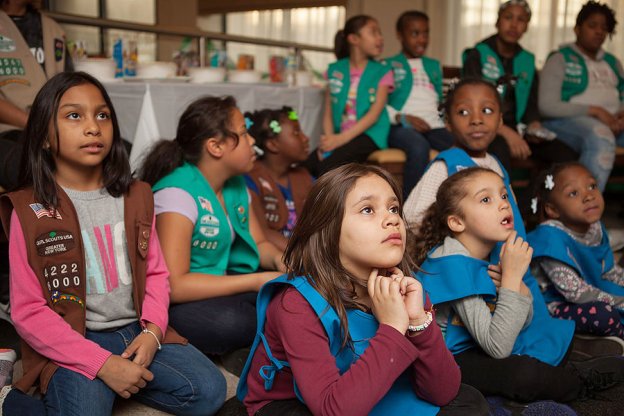
“As the first Girl Scout troop in New York designed specifically for homeless girls, Troop 6000 began in February as a modest effort to help bring a sense of community, if not normalcy, to the 100 families with children who lived in a Queens shelter…”-The Christian Science Monitor
Girls living in a homeless shelter in New York City have found hope and friendship through the creation of their own Girl Scouts Troop. It all started with one homeless mother, Giselle Burgess,wanting to create something positive for her girls and others living in a homeless shelter and now there is funding for Girl Scout Troops to be established in an additional 14 homeless shelters in NYC.
Troop 6000 appeared on The View and received some special support:
A recent count revealed 58,000 homeless people in Los Angeles County. Of those there are 17,000 who are chronically homeless.
“The chronic homeless population — defined as those who have been on the streets at least a year or multiple times and suffering mental illness, addiction or physical disability — increased 20% to more than 17,000, despite increasing numbers placed into housing.”-LA Times
The problem of the homeless with severe mental illness seems almost insurmountable because this population often resists offers of assistance and current laws which prevent forced hospitalization state that a person must be a threat to themselves or others and unable to provide for their basic needs for food, clothing and shelter.
This is a positive story about the efforts of a small Southern California community, how they were able to bring a homeless woman, known as Pretty Blonde, to the mental health care she needed and reunite her with family. I read about her in the LA Times article by Steve Lopez, The Mystery Homeless Woman of Pacific Palisades and the village that helped her home.
Art is a way that people can express and process their experience of life. It allows them to express emotions, perceptions, and provides a way for their spirit to be free of the limits of the physical or psychological environment. This post was inspired by a two posts on Hyperallergic “Seeking Escape in Painting,” and “A Painter’s Dreams Go Up In Smoke,” about an artist, Brandi Twilley, who paints a picture of her bleak childhood surroundings yet includes a window with a beautiful blue sky.
“The paintings, which mainly feature the home Twilley grew up in until it burnt to the ground when she was 16, depict windows in a subtly astute manner. They function as portals in curious ways: they indicate the painter’s glimpse of spaces beyond the bleak circumstances of that house, and in seeing the significance of these spaces through Twilley’s hand, I identify with her and wish for that slim chance of escape.”-Seph Rodney Hyperallergic
This brings home to me how powerful and essential art is to our lives. It may be the only way for some people to express themselves, it is their language and best or only way of communicating. Supporting art in schools and the community is as important as supporting language arts, math and science.
Matt D’Arrigo who started the nonprofit ARTS ( A Reason To Survive) in San Diego says,
“Having the arts taken out of schools is a form of identity theft,” ….. “There are lots of creative, artistic youth who are being told to fit into certain boxes. They are being told that what they do is nice, but it’s not important. That’s saying they are not important.”
To eliminate the opportunity for people to develop their artistic gifts is wrong. Here’s the article about ARTS.
“ARTS started with a single success story: D’Arrigo’s. He was unclear about his own identity and purpose when his sister and mother were simultaneously stricken with cancer. He left college his freshman year to care for them, and, in the process, found solace in painting and music.”-James Chute San Diego Union Tribune
Hiroshi “Hershey” Miyamura, a Japanese American, grew up in Gallop, New Mexico. He was a young man when the Japanese bombed Pearl Harbor and President Roosevelt signed the order to move all West Coast Japanese Americans to internment camps.
“In February 1942, President Franklin D. Roosevelt signed Executive Order 9066, the first of the orders that would ultimately incarcerate 120,000 West Coast Japanese, more than 60% of them citizens of the United States.”-Joe Mozingo LA Times
Partial Summary from LA Times article: This was not mandated in New Mexico because it was considered outside of the coastal military zone. Some cities in New Mexico still decided to participate in the removal of Japanese Americans. Gallop’s sheriff, Dominic Mollica, did not think it was the right thing to do. Hiroshi Miyamura went on to be a hero in the Korean War, saving his squad and another squad leader. He was captured by the Chinese and carried his wounded friend Joe Annello in a forced march. Hiroshi Miyamura won the Congressional Medal of Honor. He was greeted as a hero on his return to Gallop and was recognized with a statue, a new high school and Freeway interchange named in his honor.
Hiroshi Miyamura receives the Congressional Medal of Honor from President Eisenhower
Jim Kanno was one of American’s first Japanese American mayors. He spent his last years of high school in an internment camp. This LA Times article tells his story and mentions there were people in Orange County, California who helped his family save their farm while they were interned.
Were there others who did the right thing when Japanese Americans were removed from their homes? One who did was Bob Fletcher, a California State Agricultural Inspector, who gave up his job to take care of the farms of 3 Japanese American families while they were in an internment camp. Many other Japanese Americans lost their homes and businesses during the internment.
“Few people in history exemplify the best ideals the way that Bob did,” said Tsukamoto’s daughter, Marielle, who was 5 when her family was interned. “He was honest and hard working and had integrity. Whenever you asked him about it, he just said, ‘It was the right thing to do.’ ” (The Sacramento Bee/Washington Post)
Bob Fletcher died at the age of 101 in 2013. Here is his story.
There are several books about the Japanese American interment during WWII. Here’s a few:
Houston, Jeanne Wakatsuki Farewell to Manzanar : a true story of Japanese American experience during and after the World War II internment / Jeanne Wakatsuki Houston and James D. Houston.
“But nothing important, or meaningful, or beautiful, or interesting, or great, ever came out of imitations. What is really hard, and really amazing, is giving up on being perfect and beginning the work of becoming yourself.”-Anna Quindlin
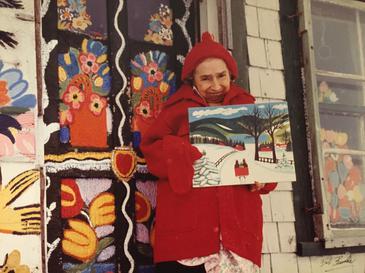
Is expressing ourselves creatively essential to our well-being and lives even if we are never famous, never receive recognition? It is great to hear about an artist who continued to create because that was what she had to do. She did not have any formal training but did it anyway. Eventually she was able to receive recognition and some income from her art. This post is dedicated to all of us who want to express our creativity and may never be recognized.
Maud Lewis had rheumatoid arthritis and lived in a small house without indoor plumbing or electricity. “Her pleasure didn’t come from the pride of having done a painting, but the creative act itself and the enjoyment others seemed to get from her work.”-Art Gallery of Nova Scotia
I am sharing a post from Hyperallergic by Olivia Gauthier about the film Maudie.








 Notes Tied On The Sagebrush